
Downtown Ottawa commercial properties face a unique set of roofing demands. Flat roofs are a practical and common choice for office buildings, mixed-use developments, retail plazas, industrial spaces, restaurants, institutional buildings, and multi-unit properties because they maximize usable building space, simplify mechanical placement, and suit modern urban construction. However, flat roofing in a dense urban environment also comes with higher expectations for drainage, durability, weather resistance, service access, and maintenance discipline.
A flat roof is never just a top layer of material. It is a complete protective system that shields the structure from water intrusion, freeze-thaw cycles, UV exposure, wind uplift, ponding water, snow loads, mechanical wear, and temperature fluctuations. In Downtown Ottawa, where harsh winters, wet shoulder seasons, and hot summer sun all affect building performance, a professionally designed and maintained flat roof becomes one of the most important long-term investments a property owner can make.
For commercial property owners, building managers, landlords, and developers, flat roofing decisions influence far more than appearance. They affect tenant comfort, operating costs, asset value, insurance exposure, maintenance budgeting, and the overall lifespan of the building envelope. A poor roofing decision can result in repeated leaks, interior damage, mold issues, insulation failure, and costly disruption to business operations. A strong roofing strategy, on the other hand, creates stability, lowers risk, and protects the building year after year.
Why Flat Roofing Is the Practical Choice for Downtown Ottawa Commercial Buildings
Flat roofing remains the standard for many commercial buildings because it offers clear practical advantages over steep-slope alternatives. In an urban setting like Downtown Ottawa, where lot efficiency, rooftop equipment access, and architectural simplicity matter, flat roof assemblies provide flexibility that many property owners need.
Commercial buildings often require HVAC units, venting systems, communications equipment, drains, skylights, and other rooftop components. Flat roofs make access easier for servicing these systems while allowing efficient space planning. They also support a cleaner exterior profile for modern business properties, especially on multi-storey buildings where appearance, utility, and cost all matter.
From a construction standpoint, flat roofs can also be easier to inspect and manage over time. Instead of dealing with steep angles and more complex access challenges, roofing professionals can evaluate seams, drains, flashings, penetrations, and membrane conditions more directly. That matters when preventative maintenance is the difference between a minor repair and a major emergency.
For property owners already investing in broader exterior protection, it also makes sense to work with a contractor familiar with complete building-envelope performance, including roofing services in Ottawa and related exterior systems that interact with drainage, insulation, and weather protection.
What “Flat Roofing Solutions” Really Means for Commercial Properties
Flat roofing solutions are not limited to patching a leak after water appears inside the building. True commercial expertise involves diagnosis, system design, material selection, detailing, drainage planning, installation quality, ongoing inspections, and lifecycle management.
A flat roof solution should begin with the building itself. The age of the structure, current insulation levels, presence of rooftop units, parapet wall conditions, slope design, drain placement, prior repairs, and occupancy type all shape the right approach. A downtown restaurant, for example, has different roofing demands than an office building or warehouse. Grease exhaust, rooftop traffic, mechanical penetrations, and interior humidity levels all influence how the roofing system should be built and maintained.
The right solution also depends on business continuity. Commercial clients often cannot afford prolonged disruption. Roofing work needs to be planned around access constraints, parking limitations, tenant schedules, loading zones, weather windows, and safety requirements. Downtown work requires logistical discipline just as much as technical skill.
That is why experienced contractors focus on the full roofing assembly rather than surface-level fixes alone. If insulation is saturated, if flashing details are failing, if drainage is inadequate, or if repeated repairs are masking deeper structural issues, a real solution addresses the underlying cause rather than extending the problem.
The Most Common Flat Roofing Problems in Downtown Ottawa
Flat roofs in Ottawa are exposed to heavy environmental stress. Commercial owners in downtown areas often encounter recurring issues that can quietly worsen before obvious interior signs appear.
Ponding Water and Drainage Failure
Ponding water is one of the most common flat roof concerns. Although many people call them “flat” roofs, they are actually designed with low slopes to encourage drainage. When the slope is insufficient, drains are blocked, insulation has settled, or structural sag develops, water can sit on the roof too long. Over time, this accelerates membrane wear, increases leak risk, and adds unnecessary weight to the structure.
Membrane Deterioration
All roofing membranes age. Constant UV exposure, freeze-thaw movement, foot traffic, and poor seam integrity can gradually weaken the surface. Cracking, blistering, splitting, shrinking, or seam separation are all warning signs that the roofing system is no longer performing at the level it should.
Flashing and Penetration Failures
Many commercial leaks do not begin in the large open field of the roof. They begin at transitions and details: curbs, edges, vents, skylights, drains, parapet walls, and equipment penetrations. When flashing is poorly installed or begins to separate over time, water finds entry points quickly.
Snow and Ice Stress
Ottawa winters are unforgiving. Snow loads, ice accumulation, meltwater back-up, and repeated freeze-thaw cycles can expose weak points fast. Proper drainage design and winter inspection planning are essential in this climate. Property owners thinking about year-round exterior performance should also understand the seasonal overlap between roof protection and broader exterior planning, including winter roofing maintenance for Ottawa homeowners.
Hidden Moisture Inside the Roofing Assembly
Sometimes the most expensive roofing problems are the ones that remain invisible for too long. Moisture can enter the roofing system and saturate insulation or decking before interior staining even appears. Once trapped, this moisture reduces thermal performance and can compromise surrounding materials.
Best Flat Roofing Systems for Commercial Buildings
Not every flat roofing material is right for every property. Commercial roofing expertise means choosing a system based on performance requirements, building use, maintenance expectations, and budget.
EPDM Roofing
EPDM is a durable synthetic rubber membrane known for flexibility and weather resistance. It performs well in cold climates and can be a reliable option for certain commercial applications. Its long track record makes it a common choice, especially where straightforward performance matters more than decorative appearance.
TPO Roofing
TPO membranes are popular in commercial settings because of their heat-reflective properties, seam strength, and modern performance profile. TPO can be a strong choice for energy-conscious property owners looking to reduce rooftop heat absorption during warmer months.
Modified Bitumen Roofing
Modified bitumen systems remain a trusted option for many low-slope roofs. Built for resilience and layered protection, they are often selected where durability and puncture resistance are priorities. For buildings with regular rooftop access, these systems can offer dependable value.
Built-Up Roofing
Built-up roofing systems use multiple layers for redundancy and durability. These roofs have been used in commercial applications for decades and can be highly effective when installed and maintained properly. For certain older downtown buildings, this approach may align well with structural needs and long-term use.
Metal Integration and Specialty Assemblies
Some downtown commercial roofs involve hybrid systems, transitions, or accessory areas where specialized materials are required. In these cases, experience with metal roofing company services in Ottawa can be relevant for edge details, architectural features, or adjoining roof sections.
Why Commercial Flat Roof Installation Quality Matters More Than Cheap Pricing
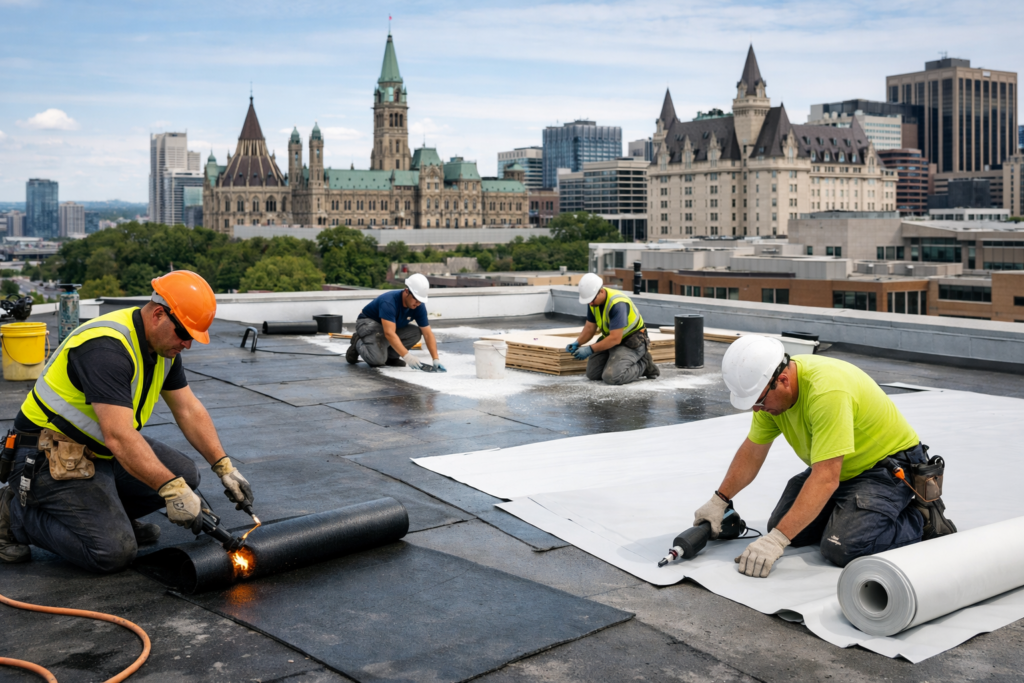
Commercial roofing failures are often installation failures. Even premium materials will underperform when seams are weak, flashing is rushed, drainage is overlooked, or penetrations are handled carelessly. A lower quote may look attractive at first, but commercial property owners usually pay for shortcuts later through emergency calls, repeat patching, interior cleanup, and shortened roof lifespan.
Proper flat roof installation requires precise substrate preparation, moisture control, fastening or adhesion discipline, clean seam work, accurate flashing transitions, drainage planning, and post-installation inspection. The building should not just receive a new membrane. It should receive a complete, coherent waterproofing system.
That is why it is important to work with a qualified roofing company in Ottawa that understands how downtown commercial conditions affect material handling, access, staging, safety, and project sequencing.
Energy Efficiency and Operating Cost Benefits of Modern Flat Roofing
A flat roof does more than stop water. It plays a direct role in thermal performance and long-term energy efficiency. On commercial buildings, heat loss and heat gain affect monthly operating costs significantly. Insulation upgrades, reflective membranes, sealed penetrations, and moisture-free roof assemblies all contribute to a more stable interior environment.
When a roof system is failing, the building often pays twice: once through repair needs and again through lost energy efficiency. Saturated insulation is especially damaging because it reduces resistance to heat flow while often remaining undetected below the surface.
Modern flat roofing upgrades can improve indoor comfort, reduce strain on HVAC systems, and support broader building-envelope improvements. For commercial owners looking at full exterior planning rather than isolated fixes, there is value in understanding integrated upgrades through resources like Ottawa’s guide to durable and stylish roofing and siding upgrades.
For broader guidance on energy performance in buildings, resources from the Government of Canada’s energy efficiency programs are useful for understanding how envelope improvements can support long-term savings. Likewise, the National Research Council of Canada provides valuable building science information relevant to performance, durability, and climate-responsive construction.
Flat Roof Maintenance: The Difference Between Predictable Costs and Expensive Emergencies
The most cost-effective commercial roofing strategy is rarely “install and forget.” Flat roofs require a maintenance plan. That does not mean constant repairs. It means disciplined inspection and small preventive actions that stop major failures from developing.
A proper commercial maintenance program should include seasonal inspections, drain clearing, debris removal, membrane review, flashing checks, rooftop penetration assessment, and documentation of changes over time. Rooftop traffic should also be controlled. Service technicians accessing HVAC equipment can unintentionally damage the membrane if walk paths and protective measures are ignored.
For downtown property owners, maintenance is especially important because service interruptions affect tenants, customers, and business operations. A small leak in a retail unit or office building can quickly become a tenant issue, a reputation issue, and a claims issue.
Key Signs a Flat Roof Needs Immediate Professional Attention
Persistent ponding after rainfall
Water that remains on the roof long after precipitation is a warning sign of drainage or slope problems.
Interior ceiling stains or unexplained moisture
Visible leaks usually mean water has already been traveling through the assembly.
Blisters, open seams, or membrane cracks
Surface damage should never be ignored, especially before winter or during seasonal thaw cycles.
Loose flashing around penetrations or parapets
Detail failures are among the most common leak sources on commercial roofs.
Rising repair frequency
When patching becomes routine, the system may be reaching the point where replacement is more cost-effective than continued repair.
Repair or Replace? Making the Right Commercial Roofing Decision
One of the biggest questions property owners face is whether to continue repairing a flat roof or move forward with replacement. The answer depends on roof age, frequency of leaks, moisture penetration, structural condition, energy performance, and budget planning.
Repair makes sense when the roof still has useful life left and the issue is localized. A targeted repair can restore performance if the surrounding system is still sound. But when the same problems return repeatedly, or when hidden saturation and broader membrane failure are present, replacement often becomes the smarter financial decision.
Commercial property owners should think in terms of lifecycle cost rather than immediate invoice size. A cheaper repair strategy that leads to repeated disruption, damaged insulation, and interior restoration can easily cost more than proactive replacement. The best decision is the one that stabilizes the building and reduces uncertainty over the coming years.
How Downtown Ottawa Logistics Affect Commercial Roofing Projects
Roofing in a dense urban core is different from roofing in suburban settings. Downtown Ottawa projects often require more planning because access is tighter, neighboring buildings are closer, deliveries are more controlled, and tenant activity must be respected.
Commercial roofing work may need coordination around:
- street access and loading restrictions
- pedestrian protection requirements
- rooftop equipment access
- business operating hours
- multi-tenant communications
- noise and safety planning
- waste removal logistics
- staged material delivery
These realities make commercial expertise especially important. A contractor must understand not only membrane systems and drainage design, but also how to manage a professional project in a live downtown environment.
What to Look for in a Downtown Ottawa Flat Roofing Contractor
Choosing the right contractor matters as much as choosing the right roofing system. Commercial owners should look beyond basic pricing and focus on competence, process, documentation, and communication.
A strong contractor should be able to explain the current condition of the roof clearly, identify causes rather than symptoms, recommend materials appropriate to the building, outline the scope in detail, and discuss realistic expectations for repair versus replacement. They should also understand related exterior systems, because roofs do not work in isolation from drainage, fascia, wall transitions, windows, and envelope details.
Property owners evaluating roofing partners should prioritize inspection quality, experience with low-slope systems, detail knowledge, clear quoting, warranty transparency, and a practical maintenance mindset. Commercial roofing is not just a trade service. It is building protection management.
Flat Roofing as a Long-Term Asset Strategy
A good commercial flat roof does more than protect against rain. It supports leasing confidence, lowers risk exposure, improves operational predictability, and protects capital value. For owners of downtown properties, that matters even more because tenant expectations are high and interruptions are costly.
The most successful roofing projects are proactive, not reactive. They begin with careful assessment, move through intelligent material and design decisions, and continue with a maintenance strategy that preserves performance. This is especially important in Ottawa’s climate, where snow, ice, rain, wind, and seasonal temperature swings put every roof under pressure.
Flat roofing should be approached as part of a long-term asset strategy. When done properly, it improves building resilience, reduces future surprises, and protects both the structure and the businesses operating beneath it.
Why Flat Roofing Expertise Matters in Downtown Ottawa
Downtown Ottawa demands more from commercial roofing than many other environments. Buildings are exposed to weather extremes, access constraints, mechanical complexity, and high occupancy expectations. A flat roof in this setting must do its job every day without fail. That requires more than a patchwork approach. It requires commercial expertise, detail-driven installation, disciplined maintenance, and a contractor who understands the building as a complete exterior system.
For property owners who want dependable performance, lower long-term risk, and a roof system built for Ottawa conditions, the right flat roofing solution is one that prioritizes drainage, durability, energy performance, and professional execution from the beginning.
FAQs
What is the best flat roofing material for a commercial building in Downtown Ottawa?
The best material depends on the building’s size, use, drainage design, rooftop traffic, and budget. TPO, EPDM, modified bitumen, and built-up roofing are all common commercial choices. The right decision should be based on building-specific performance needs rather than a one-size-fits-all approach.
How long does a commercial flat roof typically last?
Lifespan varies by material, installation quality, maintenance history, and weather exposure. A properly installed and maintained flat roof can last for many years, but neglected drainage, poor repairs, and unaddressed membrane damage will shorten its service life significantly.
Can a leaking flat roof always be repaired instead of replaced?
Not always. Small, localized issues can often be repaired, but repeated leaks, saturated insulation, widespread seam failure, or aging materials may make replacement the more cost-effective long-term solution.
Why do flat roofs leak more often than sloped roofs?
Flat roofs are not necessarily inferior, but they are more dependent on proper drainage, seam integrity, flashing performance, and regular maintenance. If water remains on the surface too long or if details fail, leaks can develop quickly.
How often should a commercial flat roof be inspected?
At minimum, commercial flat roofs should be inspected seasonally and after major storms. Regular inspections help identify drainage issues, membrane wear, and flashing concerns before they become expensive interior problems.
Is flat roofing a good option for mixed-use and retail buildings in Ottawa?
Yes. Flat roofing is widely used on retail, office, industrial, and mixed-use properties because it supports rooftop equipment, simplifies access, and suits modern commercial construction. The key is proper system design and ongoing maintenance.
Contact Kaloozie Comfort
For commercial and exterior upgrade planning in Ottawa, visit the Kaloozie Comfort contact page to discuss your project.