
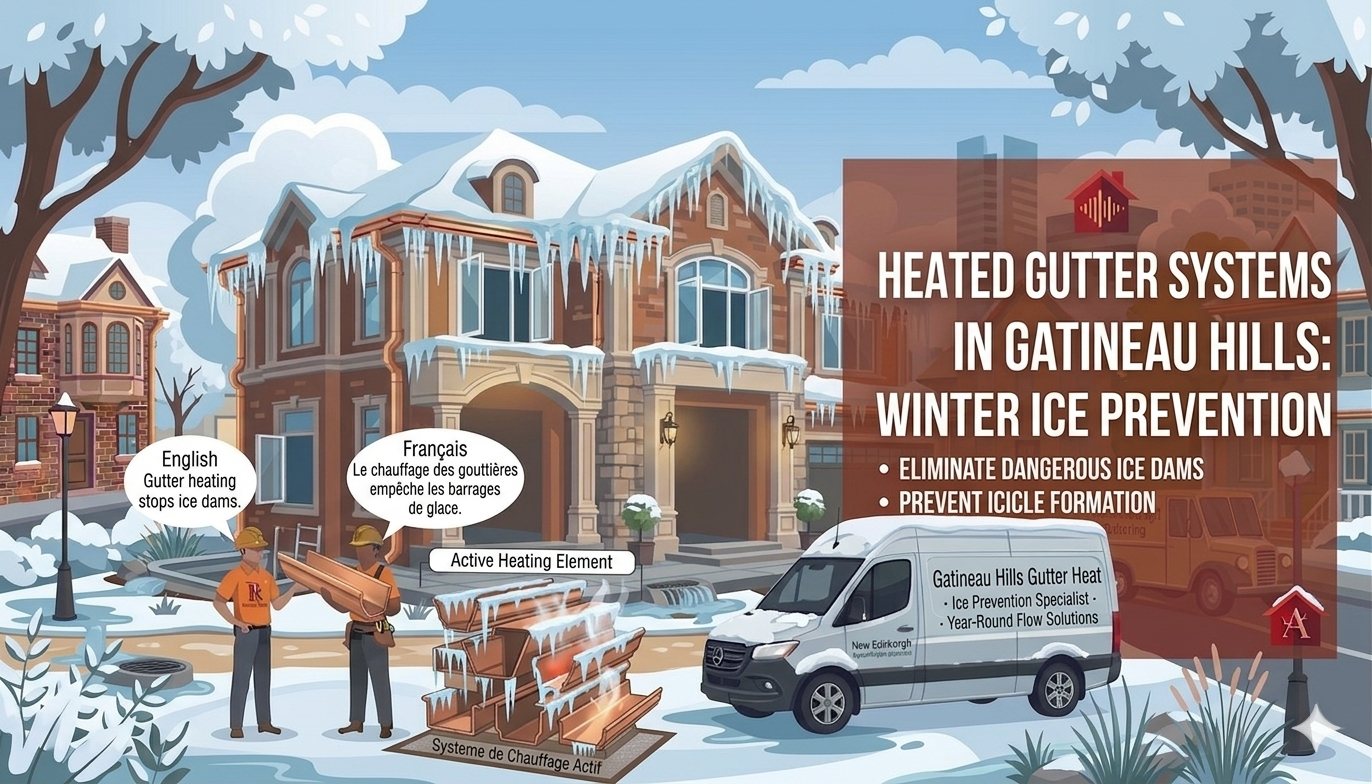
Winter in Gatineau Hills is not mild, forgiving, or easy on a home’s exterior. Heavy snowfall, repeated freeze-thaw cycles, roof runoff, and deep cold can turn an ordinary gutter system into a major liability. What begins as a small ridge of ice at the roofline can quickly become a chain reaction: blocked gutters, overflowing meltwater, dangerous icicles, fascia damage, soffit deterioration, roof leaks, and moisture intrusion into walls. For homeowners in this region, winter water management is not a seasonal afterthought. It is part of protecting the structure itself.
Heated gutter systems are one of the most practical solutions for winter ice prevention in cold, snow-heavy climates. When designed and installed properly, they help keep drainage paths open, reduce the risk of ice dams, and allow melting snow to move safely away from the roof edge and foundation. In a place like Gatineau Hills, where elevation, tree cover, drifting snow, and long freezing periods all intensify winter stress on exterior systems, heated gutters are not a luxury feature. They are a strategic upgrade for homeowners who want long-term protection.
A properly functioning winter drainage system does much more than keep gutters from freezing. It helps preserve roofing materials, reduce the likelihood of interior leaks, protect siding and trim, and limit the kind of hidden moisture damage that often goes unnoticed until repairs become expensive. Homes that already experience overflow, thick icicles, uneven roof melt, or recurring ice buildup along the eaves are especially strong candidates for a heated gutter system.
Why Gatineau Hills Homes Face More Severe Winter Ice Problems
The Gatineau Hills area presents a combination of conditions that make ice buildup more aggressive than in many lower-exposure neighborhoods. Cold temperatures alone are not the only problem. The real issue is the repeated fluctuation between snow accumulation, partial melt, and refreezing. When daytime sun warms sections of the roof but nighttime temperatures plunge again, meltwater travels downward and freezes at colder roof edges, inside gutters, or within downspouts.
This is where trouble begins. Once ice forms inside a drainage channel, water loses its escape route. It backs up behind the blockage, spreads under shingles or around flashing details, and freezes in layers. Each new cycle adds thickness and weight. The result is not only visible ice but also structural stress. Gutters can sag, brackets can loosen, joints can separate, and water can be redirected behind fascia boards instead of flowing away from the home.
Homes in wooded, sloped, or wind-exposed areas are particularly vulnerable. Snow distribution is often uneven, meaning one roof section may thaw while another remains deeply frozen. Valleys, overhangs, dormers, and complex rooflines make the situation worse by concentrating runoff. For many homeowners, the issue is not that their gutters are poor quality. It is that conventional gutters alone were never designed to manage extreme freeze-thaw conditions without additional winter protection.
That is why many homeowners exploring exterior upgrades also look at related drainage and envelope improvements such as eavestrough installation in Ottawa, especially when older drainage systems are undersized, improperly sloped, or already showing seasonal failure.
What a Heated Gutter System Actually Does
A heated gutter system uses specialized heating elements, commonly self-regulating or constant-wattage cables, to maintain a clear path for meltwater along the roof edge, gutter trough, and downspout. The goal is not to melt all the snow on the roof. That is a common misconception. The goal is to keep specific drainage channels open so water can escape before it refreezes into blockages.
This targeted approach is what makes the system effective. Rather than trying to heat the entire roof surface, the cables are positioned where ice problems usually begin and where drainage continuity matters most. These areas typically include roof eaves, gutter bottoms, outlet points, troublesome valleys, and the upper sections of downspouts. When heat is applied consistently in those critical areas, the system helps maintain flow and reduces the risk of backup.
For Gatineau Hills homeowners, this matters because the biggest damage often comes from trapped meltwater, not just from snow sitting harmlessly on the roof. When water can drain properly, the home’s roofline stays drier, ice ridges are less likely to grow aggressively, and the strain on adjacent components is reduced.
A heated gutter system works best when paired with sound exterior design principles. Proper flashing, attic insulation, air sealing, roof ventilation, and a well-maintained exterior envelope all contribute to better winter performance. Homeowners already evaluating broader weather resilience may also benefit from understanding winter roofing maintenance essential tips for Ottawa homeowners, since roofing and drainage issues are closely connected in harsh winter conditions.
The Main Benefits of Heated Gutters for Winter Ice Prevention
Reduced Ice Dam Formation
One of the primary reasons homeowners install heated gutter systems is to reduce the risk of ice dams. Ice dams form when melting snow refreezes at the colder edge of the roof, creating a frozen barrier that blocks water from draining. Heated systems help keep that edge drainage path open, which limits the buildup of backed-up water and reduces pressure on roofing materials.
Protection for Gutters, Fascia, and Soffits
Ice is heavy. When it accumulates inside gutters, it adds significant weight to a system that may already be under stress from snow loads. Over time, this can pull gutters away from the home, damage fascia boards, or distort the pitch of the trough. Heated systems lower the chance of solid ice masses forming in the first place, which helps preserve the integrity of the drainage assembly.
Less Risk of Interior Water Damage
When meltwater cannot escape through the gutter, it often finds another route. That route may be behind the fascia, beneath shingles, into the attic edge, or down inside the wall assembly. Even a small amount of repeated winter water intrusion can cause insulation damage, staining, mold risk, and costly repairs. Heated gutters help manage this threat by keeping the drainage exit functional during the periods when failure is most likely.
Improved Safety Around Entryways and Walkways
Overflowing gutters and frozen downspouts often create secondary hazards below. Water can spill over roof edges and refreeze on steps, porches, driveways, and walkways. Large icicles can also form where water repeatedly drips and freezes. A well-designed heated gutter system can help reduce these hazards by managing the flow before it turns into dangerous ice at ground level.
Lower Maintenance Stress During Winter
Without a heated system, some homeowners attempt repeated manual de-icing or emergency gutter clearing during the coldest part of the year. That approach is inconvenient, risky, and rarely a long-term fix. Heated gutters provide a more controlled and preventative solution, reducing the need for reactive winter intervention.
Where Heated Gutter Systems Work Best on a Home
Not every home requires the same configuration. Some properties benefit from full perimeter coverage, while others only need protection in problem areas. The best installations are based on the roof design, drainage pattern, shading conditions, and the home’s history of winter ice buildup.
Common priority areas include:
Roof Eaves
This is where warm meltwater from higher roof sections meets colder exterior temperatures and starts to refreeze.
Gutters and Outlet Points
These are the main channels where water needs to stay moving. If the outlet freezes, the whole system becomes ineffective.
Downspouts
Even if the gutter itself is partially clear, frozen downspouts will still trap water in the trough. Heated continuity through the downspout is often essential.
Valleys and Problem Roof Transitions
Roof valleys collect concentrated runoff. If they are prone to freezing, they can create severe water backup.
Homes with recurring overflow or moisture-related exterior issues should also consider how siding, drainage, and weather protection interact. For example, homes already dealing with drainage failure at the roof edge may benefit from guidance on eavestrough siding integration stop overflow and rot at the eaves, since the roofline and wall system do not fail independently.
Signs a Home in Gatineau Hills May Need Heated Gutters
A heated gutter system is often the right solution when a home shows repeat winter warning signs year after year. These indicators should not be ignored, especially if they have already led to repairs or water staining.
Large Icicles Forming from the Same Areas
Consistent icicle formation often points to concentrated runoff and freezing at a blocked or underperforming edge.
Ice-Filled Gutters
If gutters turn into solid ice troughs during winter, they are no longer functioning as drainage components.
Water Stains Near Exterior Walls or Ceilings
This may indicate that meltwater is backing up and entering the structure.
Overflow During Sunny Winter Days
When water drips over gutter edges in daylight and then freezes again at night, it usually means the drainage path is blocked.
Sagging or Pulled-Away Gutters
The repeated weight of ice can deform fastening points and create permanent alignment problems.
Recurring Freeze Problems Despite Gutter Cleaning
If clean gutters still freeze repeatedly, the issue is likely climate exposure and roof-edge conditions rather than debris alone.
Heated Gutters vs Standard Gutter Guards and Cleaning Alone
Gutter cleaning is important, and gutter guards can reduce debris buildup, but neither one solves the core winter problem in a cold-climate freeze-thaw cycle. A clean gutter can still freeze solid. A guarded gutter can still become blocked by ice. These tools may help with leaf control and routine maintenance, but they do not actively maintain a drainage channel during subzero conditions.
Heated gutter systems serve a different purpose. They address the ice formation process directly by keeping key pathways warm enough for water to move through them. In many cases, the best-performing winter drainage strategy involves a combination of properly sized gutters, good slope, correct downspout placement, insulation improvements, and targeted heating where necessary.
For homeowners reviewing broader gutter upgrades, it is also useful to compare drainage system performance and installation quality through a service page such as eavestrough installation Gatineau, especially when the current system is older or poorly configured for regional weather.

Installation Considerations That Matter Most
A heated gutter system is only as good as its design and installation. Poor cable placement, inadequate circuit planning, weak attachment methods, or incomplete downspout coverage can all reduce effectiveness. In winter performance systems, the details matter.
Electrical Planning
The system must be sized appropriately for the coverage area and installed according to applicable electrical requirements. Safe routing, weather-resistant components, and proper controls are essential.
Cable Type
Different cable technologies offer different benefits. Self-regulating cables adjust heat output based on surrounding temperature, which can improve efficiency in variable winter conditions.
Control Strategy
Some systems operate manually, while others use thermostats or moisture sensors. Automated systems generally improve energy efficiency and responsiveness because they run when conditions call for it rather than continuously.
Gutter and Roof Compatibility
The installation should work with the home’s existing roofline, eavestrough material, fascia design, and drainage layout without compromising long-term performance.
Downspout Discharge
It is not enough to heat only the gutter. Water must continue flowing beyond the outlet. Downspout freeze protection is often one of the most overlooked but important parts of the system.
Energy Use and Cost Expectations
Many homeowners hesitate because they assume heated gutters are expensive to operate. In reality, operating costs depend on cable type, length, automation level, local utility rates, and how often the system runs. A properly designed, sensor-controlled system used during the highest-risk periods is far more efficient than a poorly planned system left running unnecessarily.
The better question is not only what the system costs to operate, but what winter damage costs when prevention is ignored. Fascia repairs, leak remediation, insulation replacement, mold cleanup, ceiling staining, emergency de-icing, and gutter replacement can easily exceed the cost of a correctly installed heated system over time.
For homes where exterior upgrades are being considered as part of a more complete envelope improvement plan, combining drainage upgrades with broader service work can make practical and financial sense. Many homeowners already exploring services for siding and eavestrough find that winter prevention is most effective when improvements are coordinated rather than handled as isolated repairs.
How Heated Gutters Fit Into Whole-Home Winter Protection
Heated gutters are highly useful, but they are not a substitute for good building science. A home that loses too much heat through the attic or roof assembly will still create excessive melt patterns. A poorly ventilated attic can still contribute to uneven roof temperatures. Damaged flashing can still allow moisture entry. Weak siding or trim details can still suffer from repeated winter wetting.
That is why the best results come when heated gutter systems are treated as part of a broader winter protection strategy. Roof drainage, ventilation, insulation, wall assembly durability, and moisture management all work together. A home with effective attic air sealing, balanced ventilation, strong flashing details, and targeted heat cable protection will generally outperform a home that tries to solve everything with one product alone.
Authoritative winter maintenance guidance also supports this broader approach. Resources from Canada Mortgage and Housing Corporation and Hydro-Québec are useful starting points for homeowners who want to better understand cold-climate building performance, seasonal energy use, and moisture-related risks in Canadian housing conditions.
Common Mistakes Homeowners Make With Winter Ice Prevention
One of the most common mistakes is waiting until visible damage appears. By the time water stains show up indoors or gutters begin pulling away from the fascia, the winter drainage issue has often been developing for multiple seasons.
Another mistake is focusing only on snow volume instead of melt patterns. A roof does not need to be buried in snow to develop a serious ice problem. Even moderate snowfall can become destructive when intermittent thawing and refreezing are involved.
Some homeowners also assume that removing icicles solves the problem. It does not. Icicles are usually a symptom, not the root cause. Breaking them off may reduce immediate weight or hazard, but it does nothing to restore proper drainage within the gutter and downspout system.
A final mistake is choosing a quick-fix installation without considering the full drainage path. If cables stop short of the downspout, if outlet points are left exposed, or if the gutter itself is undersized, the system may not perform when it matters most.
Why Heated Gutter Systems Are a Smart Upgrade for Gatineau Hills Homes
Homes in Gatineau Hills face real winter exposure. Snow loads, slope-driven runoff, roof-edge freezing, and extended cold make exterior water management far more important than many homeowners realize. Heated gutter systems provide a focused, proven way to reduce winter drainage failure in the areas where problems most often begin.
They help preserve roof edges, protect wall assemblies, reduce hazardous ice accumulation, and lower the chances of expensive seasonal damage. More importantly, they bring predictability to a part of the home that too often fails during the harshest weather of the year. For homeowners tired of repeated ice buildup, emergency winter fixes, and the constant worry that every thaw could become a leak, heated gutters offer a practical and long-term solution.
When installed with the right design approach, a heated gutter system transforms a vulnerable roof edge into a controlled drainage path. In a harsh climate, that is not just a convenience. It is prevention, protection, and peace of mind.
FAQs
What is a heated gutter system?
A heated gutter system uses electric heat cables installed along roof edges, gutters, and downspouts to keep drainage pathways open during winter and reduce ice blockage.
Do heated gutters melt all the snow on my roof?
No. Their purpose is to maintain a path for meltwater to drain safely. They are not designed to melt the entire roof surface.
Can heated gutters prevent ice dams completely?
They can significantly reduce the risk of ice dam formation, especially when combined with proper attic insulation, ventilation, and effective roof-edge drainage design.
Are heated gutter systems worth it in Gatineau Hills?
For homes with recurring winter ice buildup, overflowing gutters, large icicles, or roof-edge leak risks, they are often a very worthwhile protective upgrade.
Do heated gutter systems use a lot of electricity?
Energy use depends on cable type, system size, control settings, and winter conditions. Sensor-controlled systems are generally more efficient than always-on systems.
Can heated gutter systems be installed on existing gutters?
Yes, in many cases they can be added to an existing gutter system, provided the gutters are structurally sound and the design is suitable for safe installation.
Contact
For homeowners planning winter drainage upgrades, roof-edge protection, or exterior improvements, visit the contact page to discuss the right solution for your property.