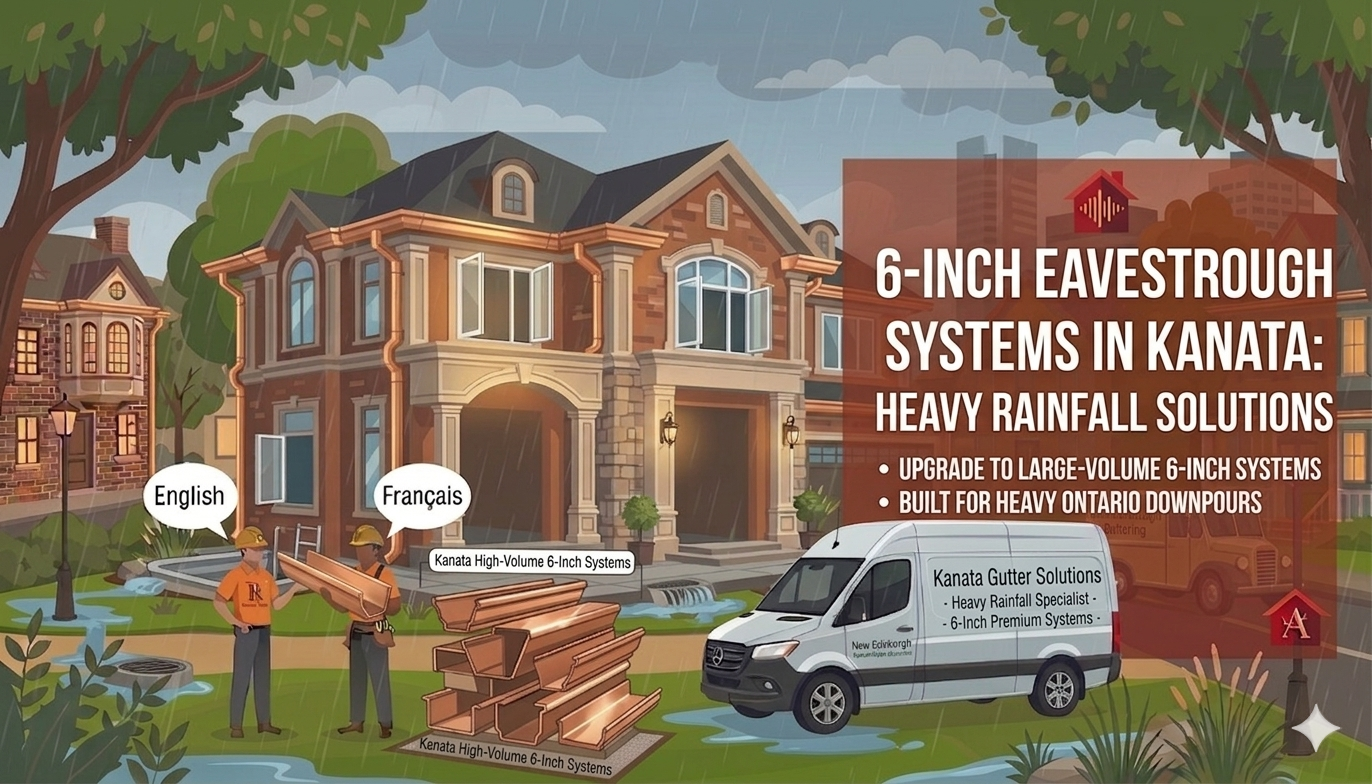
Kanata homeowners know that water management is not a small detail. It is one of the most important parts of protecting a home’s roofline, siding, soffit, fascia, foundation, landscaping, and even basement. When heavy rainfall hits, standard drainage systems can quickly become overwhelmed. Add spring melt, ice buildup, clogged downspouts, and roof runoff from large modern homes, and the result is often overflow, staining, pooling, erosion, and long-term structural damage.
That is why 6-inch eavestrough systems in Kanata have become a smarter choice for homeowners who want a more capable and more dependable solution. A properly designed 6-inch system handles higher water volume, reduces the risk of overflow during storms, and supports better drainage performance across every season. In a place like Kanata, where homes face strong seasonal changes, intense rain events, and freeze-thaw cycles, upgrading to a larger-capacity eavestrough system is not a luxury. It is a practical exterior improvement that can prevent expensive repairs later.
For homeowners planning a complete exterior upgrade, it also makes sense to look at integrated envelope protection through siding and eavestrough services, especially when water runoff is already affecting trim, walls, or lower drainage zones.
Why 6-Inch Eavestrough Systems Matter in Kanata
Many homes were originally built with smaller gutter profiles that may have been adequate on paper but are no longer ideal in real-world conditions. Roof designs have changed. Rainfall events can be heavier. Mature trees create more debris. Home additions increase runoff load. The result is simple: undersized eavestroughs often fail when they are needed most.
A 6-inch eavestrough system gives the home a larger drainage channel, which means it can capture and move more water before spilling over the edge. That extra capacity becomes especially important on:
- large roof planes
- steep-slope roofs
- homes with valleys that concentrate runoff
- houses with long fascia runs
- properties exposed to wind-driven rain
- homes in neighborhoods where grading makes drainage especially important
When water exceeds the capacity of the trough, it does not just fall harmlessly to the ground. It can run behind the gutter, soak fascia boards, stain masonry, loosen soffits, and saturate soil around the foundation. Over time, that excess water can contribute to cracks, settlement issues, mold risk, and damage to finished basement areas.
Homeowners already dealing with overflow symptoms should also review broader water-handling conditions around the building envelope. Resources like the Government of Canada’s guide on protecting homes from moisture and water intrusion can help explain why drainage details matter so much in Canadian housing performance.
How 6-Inch Eavestroughs Handle Heavy Rainfall Better
The biggest advantage of a 6-inch eavestrough is capacity. A wider trough can intercept more water from the roof edge and move it toward the downspouts with less risk of spillover. That sounds simple, but in practice it changes the performance of the whole drainage system.
During heavy rain, several things happen at once. Water volume increases rapidly. Roof valleys concentrate runoff in narrow areas. Wind can push water sideways. Leaves and debris can reduce flow. If the eavestrough is too small, even a brief downpour can force water over the front lip.
A 6-inch system improves performance in multiple ways:
More Water Capture at the Roof Edge
Larger trough dimensions mean a greater catchment area. This helps collect runoff more effectively, especially from steep or complex roofs where water arrives with speed and force.
Improved Flow Toward Downspouts
More space inside the gutter helps water move through the system without backing up as quickly. This becomes especially useful during peak rainfall.
Reduced Overflow at Trouble Spots
Corners, valleys, and long runs often become weak points in small systems. A 6-inch gutter reduces the chance that these areas become overflow zones during storms.
Better Compatibility With Larger Downspouts
Many upgraded systems pair 6-inch gutters with oversized downspouts for better discharge performance. That combination helps move water farther away from the house faster.
In neighborhoods with newer builds and larger roof footprints, this upgrade is often a more future-ready solution than simply replacing old gutters with the same undersized profile.
Kanata Weather Conditions Make Oversized Drainage a Smart Investment
Kanata homes deal with more than just occasional rain. They face a full cycle of weather stress:
- heavy spring melt
- prolonged rain events
- summer downpours
- autumn leaf buildup
- winter freezing and ice formation
Each of these conditions puts pressure on the eavestrough system. Snow and ice can restrict flow. Thaw periods create sudden runoff surges. Summer storms can dump water quickly. Fall debris can turn a moderate system into a failing one.
That is why 6-inch systems are not just about “bigger gutters.” They are about better water control under Canadian conditions. When the drainage system is undersized, every seasonal event becomes harder on the home. When the system is properly sized, the house is better protected year-round.
This is also why exterior systems should never be viewed in isolation. Water that spills from the roofline can accelerate wear on cladding, trim, and wall assemblies. Homeowners interested in total envelope protection often benefit from understanding how drainage and cladding work together, especially when planning larger exterior upgrades. A useful internal read is eavestrough and siding integration: stop overflow and rot at the eaves, which aligns closely with the moisture-control issues that affect Kanata properties.
Signs Your Current Eavestrough System Is Too Small
A lot of homeowners assume their system is working because the gutters are still attached and water appears to move during light rain. But capacity problems often reveal themselves only during heavy weather. That means many homes are underperforming without the owner realizing it.
Watch for these warning signs:
Overflow During Moderate or Heavy Rain
If water pours over the gutter edge during a storm, the system may be clogged, sloped incorrectly, or simply too small.
Water Running Behind the Gutter
This can indicate improper installation, damaged fascia, or a system that cannot catch roof runoff fast enough.
Pooling Near the Foundation
If water gathers around the base of the home after rainfall, the gutters and downspouts may not be moving enough water away.
Soil Erosion or Mulch Washout
Landscaping damage below roof edges is often a visible sign of concentrated overflow.
Staining on Siding or Masonry
Dirty runoff lines often point to splashback or gutter overflow.
Ice Buildup Along the Roof Edge
Poor drainage performance in winter can contribute to freeze-related issues and heavier ice accumulation around eaves.
If these problems are recurring, replacement with a higher-capacity system often makes more sense than repeated patch repairs.
Seamless 6-Inch Eavestrough Systems: The Better Upgrade
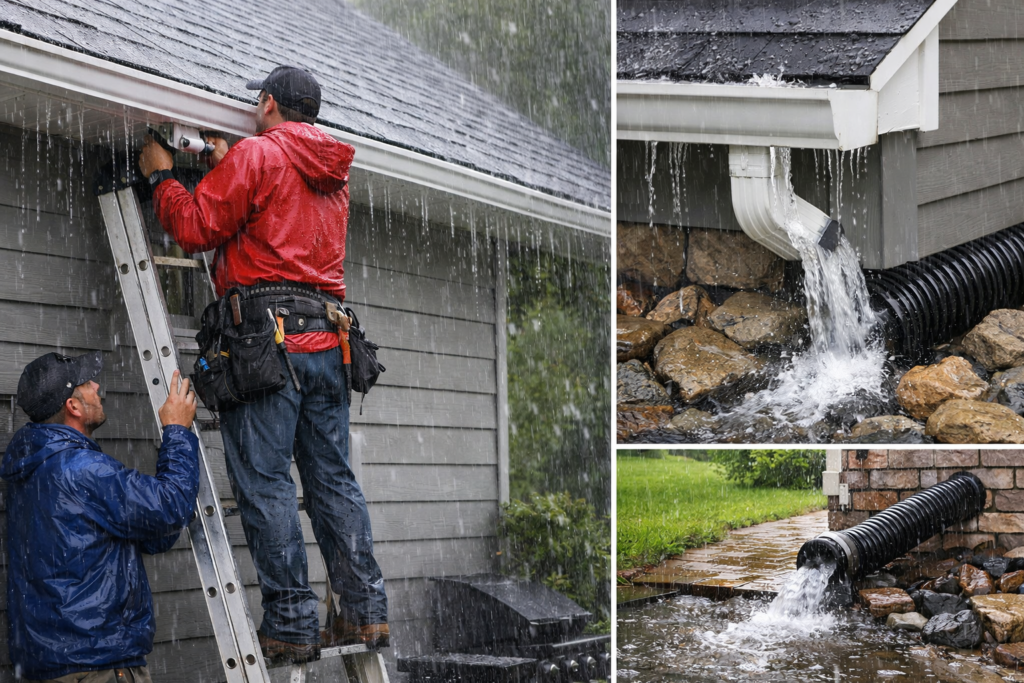
When homeowners in Kanata upgrade to 6-inch gutters, the best results usually come from seamless systems. Seamless eavestroughs are fabricated to fit the home precisely, reducing the number of joints where leaks commonly form.
The benefits are significant:
Fewer Leak Points
Traditional sectional systems have more seams, and every seam is a potential failure point.
Cleaner Appearance
Seamless profiles look more finished and more consistent along the roofline.
Lower Maintenance Burden
With fewer joints catching debris and moisture, the system is easier to maintain over time.
Longer-Term Performance
A properly installed seamless aluminum system resists corrosion, reduces leakage, and supports more consistent drainage.
For many homeowners, seamless 6-inch eavestrough installation becomes one of the highest-value exterior upgrades because it improves function and appearance at the same time.
How Proper Installation Impacts Performance
Even the best 6-inch eavestrough system can underperform if it is installed poorly. Capacity alone does not solve drainage issues. The slope, hanger spacing, outlet placement, downspout sizing, fascia condition, and runoff discharge plan all matter.
A quality installation should account for:
- roof pitch and runoff volume
- valley discharge concentration
- fascia integrity
- hanger spacing for snow load support
- downspout placement for fast water evacuation
- drainage extensions away from the foundation
- compatibility with soffit, fascia, and siding details
Poor installation creates familiar problems: sagging runs, standing water, corner leaks, separated joints, loose hangers, and water dumping too close to the house. This is why choosing a contractor with strong exterior knowledge matters. Homeowners comparing providers can also benefit from reviewing how to choose a siding contractor you can trust, because many of the same quality-control principles apply to roofline and envelope work as well.
6-Inch Eavestroughs and Foundation Protection
One of the most overlooked reasons to install larger-capacity gutters is foundation protection. Water is persistent. If roof runoff is not controlled, it will find the lowest path and saturate the soil around the home.
That repeated saturation can lead to:
- hydrostatic pressure against foundation walls
- basement seepage
- cracks or worsening of existing cracks
- settlement around walkways and porches
- damage to landscaping and grading
- frost-related movement during winter
A strong eavestrough system is the first line of defense. It intercepts roof runoff before it becomes a ground-level drainage problem. Combined with properly placed downspouts and discharge extensions, a 6-inch system helps keep water away from the foundation zone where it can do the most harm.
For homeowners who want a broader understanding of stormwater and drainage planning, the City of Ottawa’s rainwater management information is also worth reviewing.
Why 6-Inch Eavestroughs Are Ideal for Larger and Modern Homes in Kanata
Kanata has many newer subdivisions and upgraded homes with architectural features that place heavier demands on drainage systems. Large roof footprints, multiple valleys, covered porches, rear additions, and attached garages can all increase runoff volume.
A standard-size system may not be enough for:
- two-storey homes with broad roof planes
- homes with sharp roof valleys
- houses with secondary roof sections draining into one run
- premium homes with long uninterrupted fascia lines
- properties surrounded by trees and seasonal debris
In these situations, 6-inch gutters offer not just added capacity but improved reliability. Instead of constantly dealing with splash zones, erosion, and maintenance frustration, homeowners get a system built for real water volume.
Maintenance Still Matters—But the Right System Makes It Easier
A 6-inch eavestrough is not maintenance-free, but it is far more forgiving than a smaller system. Because it offers more room for water flow, it handles partial debris loads better and is less likely to overflow during a storm if some buildup is present.
Still, proper upkeep is essential. Recommended maintenance includes:
Seasonal Cleaning
Remove leaves, twigs, and granules at least twice a year, especially in spring and fall.
Downspout Checks
Make sure downspouts are clear and water exits well away from the home.
Fastener Inspection
Look for loose hangers or sections beginning to slope improperly.
Joint and Outlet Review
Even seamless systems have components that need periodic inspection.
Ice and Winter Monitoring
Watch for signs of ice blockage, especially after freeze-thaw events.
If the home already has moisture-related wear on the exterior, it is also worth reviewing storm damage checklist for your home’s exterior to identify additional problem areas that may need attention.
The Value of Combining Eavestrough Upgrades With Other Exterior Improvements
Water control, siding durability, soffit ventilation, fascia stability, and window integration all work together. When one part fails, the others often suffer. That is why many homeowners in Kanata choose to upgrade eavestroughs as part of a larger exterior improvement strategy.
This approach can deliver better long-term value because it allows the contractor to address:
- hidden fascia damage
- poor flashing details
- siding stains and moisture marks
- downspout discharge issues
- soffit or trim deterioration
- roof-edge ventilation concerns
Bundling work can also improve the finished appearance of the home and reduce the risk of repeated labor costs later. Exterior renovations are strongest when the roofline and wall system are treated as one coordinated assembly rather than disconnected pieces.
Choosing the Right Contractor for 6-Inch Eavestrough Installation in Kanata
Not every contractor approaches eavestrough installation with the same level of detail. The right provider should evaluate the property, roof geometry, drainage challenges, and surrounding exterior conditions before recommending a solution.
Look for a contractor who can clearly explain:
- why 6-inch is recommended for your roof
- how many downspouts are needed
- whether seamless fabrication is included
- how water will be discharged away from the foundation
- what materials and hanger systems will be used
- how soffit, fascia, and siding conditions affect the job
- what warranty coverage is included
An eavestrough system should never be treated like a generic add-on. It is a high-impact protective component that must be matched to the home’s real drainage needs.
Why 6-Inch Eavestrough Systems Are the Smarter Heavy Rainfall Solution
For Kanata homeowners, the case for upgrading is clear. A 6-inch eavestrough system offers stronger water capture, better storm handling, reduced overflow risk, improved foundation protection, and a more durable long-term solution for modern rooflines and demanding seasonal conditions.
It is one of the most practical upgrades a homeowner can make because it protects so many other parts of the property at once. Better drainage helps preserve siding, fascia, soffits, landscaping, walkways, and basement conditions. It also reduces the risk of those slow-building water problems that become expensive only after they have been ignored for too long.
When heavy rainfall hits, the goal is not to hope the current system can cope. The goal is to have a drainage system already built for the load.
FAQs
What is the advantage of a 6-inch eavestrough over a 5-inch system?
A 6-inch eavestrough can handle a greater volume of water, making it better for larger roofs, steep roof pitches, heavy rainfall, and homes with concentrated runoff areas like valleys.
Are 6-inch eavestrough systems worth it in Kanata?
Yes. Kanata homes face heavy rain, snowmelt, debris buildup, and freeze-thaw cycles. A 6-inch system offers better overflow protection and stronger year-round drainage performance.
Do 6-inch gutters help protect the foundation?
Yes. By capturing and directing more roof runoff away from the house, they help reduce pooling, soil erosion, and moisture pressure near the foundation.
Should 6-inch eavestroughs be seamless?
In most cases, yes. Seamless systems reduce leak points, improve appearance, and usually provide more reliable long-term performance than sectional systems.
Can oversized gutters improve performance during snowmelt?
Yes. Spring thaw can produce rapid water flow from the roof. A larger-capacity system helps manage that runoff more effectively and lowers the chance of overflow.
How often should eavestroughs be cleaned in Kanata?
At minimum, twice a year. Homes with nearby trees or recurring debris problems may need more frequent cleaning and inspection.
Conclusion
A high-capacity drainage system is one of the most important defenses a Kanata home can have against heavy rainfall, seasonal runoff, and long-term moisture damage. 6-inch eavestrough systems are built for better performance where smaller systems often fall short. They move more water, protect more of the home, and provide the kind of reliability that matters most when weather conditions are at their worst.
For homeowners ready to improve drainage performance and protect the full exterior envelope, the next step is to request a professional assessment through the contact page.