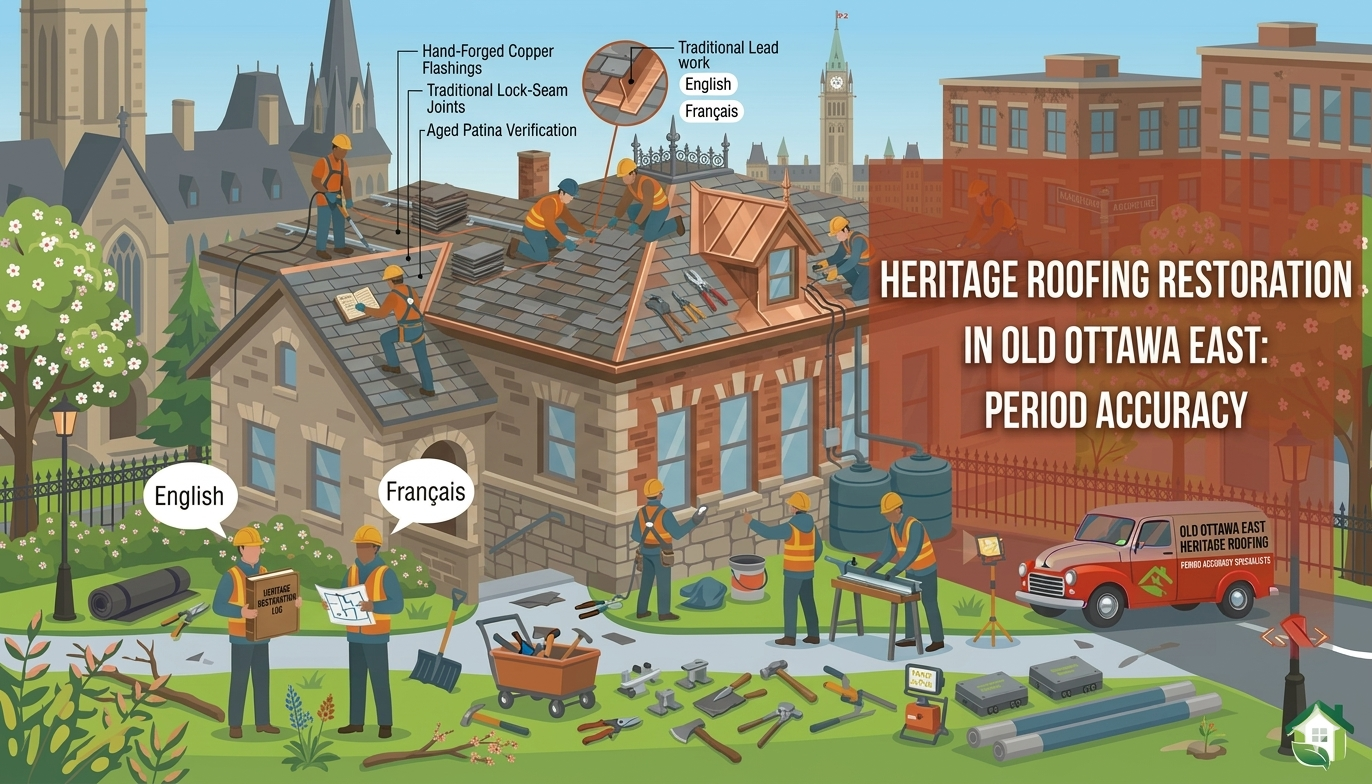
Old Ottawa East is one of Ottawa’s most character-rich neighbourhoods, known for mature streetscapes, established homes, and architectural details that deserve more than ordinary renovation work. When a historic property in this area needs roofing attention, a standard replacement approach is rarely enough. Heritage roofing restoration in Old Ottawa East calls for a more disciplined process—one that respects original proportions, protects structural integrity, and preserves the visual language that gives older homes their identity.
A roof is not just a protective shell. On a heritage home, it is one of the most defining architectural features. The slope, edge profile, ridge treatment, flashing details, chimney integration, dormer relationships, and material texture all contribute to the building’s historic character. Getting these elements wrong can flatten the appearance of the home, weaken its authenticity, and reduce the very curb appeal that makes older Ottawa properties so valuable. Getting them right can restore elegance, strengthen weather protection, and ensure the home continues to fit naturally within the neighbourhood’s historic fabric.
For homeowners in Old Ottawa East, period-accurate roof restoration is about balancing preservation with real-world performance. Ottawa’s climate demands serious durability. Snow loads, freeze-thaw cycles, driving rain, ice buildup, and seasonal temperature swings can punish older roofing systems. That means a successful heritage roofing project must respect the past while delivering reliable protection for the future. That balance is exactly what makes this type of work specialized.
Why Period Accuracy Matters in Heritage Roofing Restoration
Period accuracy is not about making a house look old for the sake of style. It is about preserving design consistency. Historic homes were built with specific roof forms and material relationships in mind. When those elements are changed carelessly, the building often loses proportion, rhythm, and authenticity.
A heritage roof is visually tied to the home’s era. The roofing material, shingle size, edge treatment, and flashing profile should feel appropriate to the architecture rather than generic or overly modern. A roof that is too flat in appearance, too glossy, too thick in profile, or finished with the wrong trim can clash with original masonry, woodwork, windows, and façade composition. In a neighbourhood like Old Ottawa East, where architectural continuity contributes to the streetscape, these mismatches become even more noticeable.
Period accuracy also matters from a value perspective. Buyers who are attracted to heritage homes often notice exterior details immediately. They may not know every technical term, but they recognize when a home feels authentic and when it feels stripped of its original character. A carefully restored roof supports long-term desirability and communicates that the property has been renovated with care rather than convenience.
Homeowners exploring broader exterior planning can also review roofing services in Ottawa to understand how professional roofing work should be approached when durability and design both matter.
Understanding the Roofing Challenges of Older Homes in Old Ottawa East
Older homes behave differently than newer builds. Many have experienced decades of patchwork repairs, inconsistent ventilation upgrades, moisture intrusion, framing movement, and layered materials that hide underlying damage. Before restoration begins, the roof must be evaluated as a complete system rather than a single visible surface.
Common issues in heritage properties include aging decking, compromised flashing around chimneys and valleys, poor attic airflow, sagging rooflines, previous overlay installations, and mismatched repairs completed with modern materials that never truly suited the building. Water damage may be concealed beneath old shingles or around roof penetrations. In some homes, structural settling may have altered drainage patterns over time.
This is one reason heritage restoration should never begin with material selection alone. The visible roof covering is only part of the project. The hidden assembly underneath often determines whether the restoration will last. When a contractor treats an older home like a standard re-roof, important clues can be missed. When the roof is approached as part of a historic building envelope, the result is stronger, cleaner, and more faithful to the original design.
For homeowners comparing exterior restoration priorities, the importance of siding and roofing offers useful perspective on how these elements work together to protect and define a home.
Choosing Roofing Materials That Respect Historic Character
Material selection is one of the most important decisions in heritage roofing restoration. The right choice depends on the age of the home, the original material or closest historic equivalent, the roof pitch, the surrounding architecture, and the desired balance between authenticity, maintenance, and lifespan.
In many heritage settings, the goal is not necessarily to replicate the exact original material at any cost. The goal is to achieve a historically appropriate appearance while meeting today’s practical demands. Some homeowners prioritize traditional visual texture and shadow lines. Others want enhanced durability with a product that still complements the home’s era.
For period-sensitive projects, key considerations include:
Profile and Scale
The thickness, reveal, and pattern of the roofing material should suit the home. Oversized or heavily dimensional products can overwhelm delicate heritage architecture.
Colour Restraint
Heritage roofs usually benefit from restrained, classic colour palettes. Overly saturated or trendy shades can disrupt the character of the property and the neighbourhood.
Texture and Finish
A flat or subtly textured appearance often aligns better with historic homes than high-gloss or aggressively patterned products.
Edge and Ridge Detailing
The roofing field should work visually with valleys, ridges, eaves, and dormers. Details matter as much as the main surface.
Homeowners considering a historically sensitive upgrade often benefit from reviewing roofing for historic homes: preserving the past with modern materials, especially when deciding how to merge architectural preservation with modern product performance.
Period-Accurate Details That Make the Biggest Visual Difference
The difference between an ordinary reroof and a true heritage restoration is often found in the details. In Old Ottawa East, those details can determine whether the finished home looks carefully preserved or visually diluted.
Chimney Flashing
Older homes often feature prominent masonry chimneys. Sloppy flashing work can undermine both performance and appearance. Period-appropriate flashing should be clean, discreet, and properly integrated without creating bulky visual interruptions.
Dormers and Roof Transitions
Dormers are defining features on many heritage homes. Their cladding transitions, valley lines, and trim connections should feel crisp and consistent with the original roof geometry.
Eaves and Overhangs
Heritage homes frequently have eave proportions that contribute to their identity. Restoration work should preserve those lines rather than bury them beneath overbuilt edges or awkward modern trims.
Ridge Treatment
The ridge should appear intentional and proportional. The wrong ridge profile can make the roof feel too contemporary.
Ventilation Placement
Modern ventilation is essential, but visible rooftop components should be handled carefully. Strategic placement helps preserve the architectural appearance while still supporting attic health.
Roof-to-Wall Integration
Where roofing meets brick, wood trim, or siding, every junction should be deliberate. Historic homes reveal poor workmanship quickly because their details are more visible and architecturally expressive.
These are not cosmetic extras. They are part of the architectural grammar of the building. When respected, they restore dignity to the home. When ignored, they create a finish that looks pieced together rather than restored.
Restoration vs Replacement: What Heritage Homes Really Need
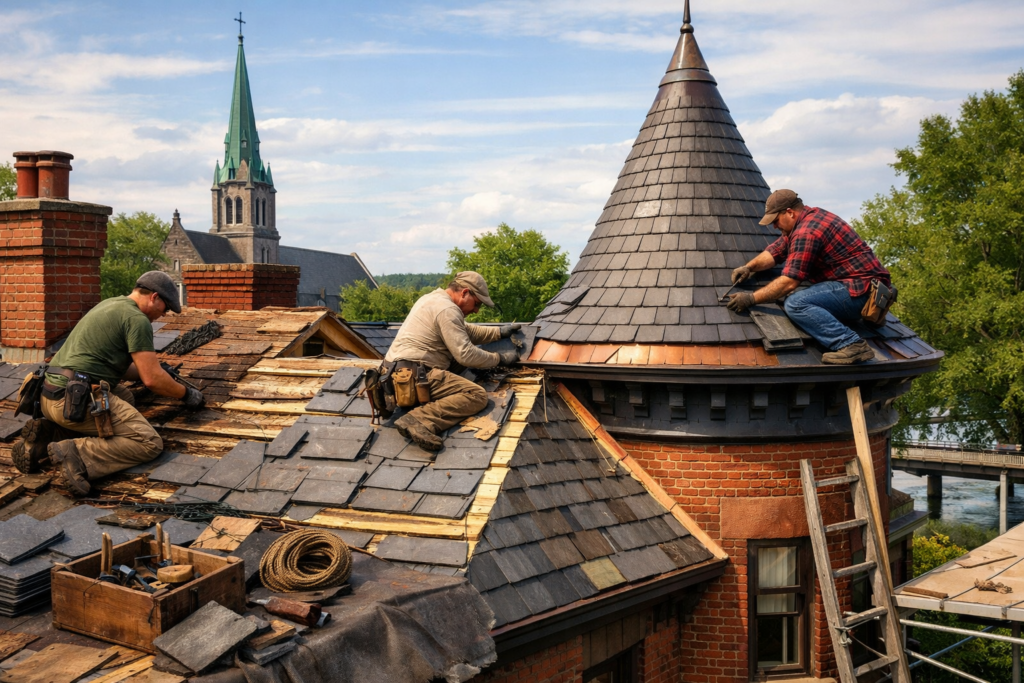
Not every heritage roof needs total replacement. Some need targeted restoration. Others need partial rebuilding with material recovery where possible. The correct path depends on condition, not assumption.
A full roof replacement may be necessary when the system has widespread failure, hidden rot, extensive water damage, or too many past modifications to restore sensibly. But in some cases, portions of the roof may still be structurally sound and historically valuable. A thoughtful assessment can identify what should be preserved, what should be repaired, and what must be replaced.
This is especially important for homeowners who want to avoid unnecessary loss of original character. A restoration mindset asks better questions. Instead of jumping straight to demolition, it examines whether original lines, trim relationships, or architectural features can be retained and reinforced.
That same disciplined approach is valuable when other envelope components are involved. For example, if water intrusion has extended beyond the roofline, homeowners may also need to consider window repair in Ottawa as part of a more complete building-envelope strategy.
How Ottawa Weather Affects Heritage Roof Performance
Old Ottawa East homes face the same severe weather realities as the rest of the city, but older structures often have less margin for error. Snow accumulation, ice dam formation, freeze-thaw expansion, moisture migration, and wind exposure can all create long-term problems if roofing details are not executed properly.
A heritage roof restoration must do more than look appropriate. It must manage water properly, shed snow effectively, protect vulnerable intersections, and support ventilation without compromising appearance. In Ottawa, this means careful attention to flashing, underlayment strategy, insulation coordination, attic airflow, and drainage control.
Freeze-thaw cycles are particularly unforgiving. Small installation flaws can become major failure points after repeated seasonal expansion and contraction. Water that enters around a chimney, dormer, or eave can remain hidden until interior damage appears. By then, repairs are more expensive and more disruptive.
Homeowners preparing for long-term exterior durability should also understand the role of drainage systems. Proper roof restoration often works hand in hand with eavestrough installation in Ottawa to direct water away from the home and reduce moisture stress around the roof edge and foundation line.
Planning a Heritage Roofing Project Without Compromising Character
A successful project starts with documentation and planning. On a period home, rushing is expensive. Before materials are ordered, the roof should be studied carefully from both performance and design perspectives.
A proper planning process usually includes reviewing the roof shape, photographing existing details, identifying original or historically appropriate visual elements, checking structural condition, evaluating drainage, and determining how modern protective components can be integrated discreetly. In some cases, homeowners may also need to account for neighbourhood heritage expectations or local planning considerations.
For practical reference, national conservation guidance can help frame these decisions. Canada’s Standards and Guidelines for the Conservation of Historic Places provide a strong foundation for thinking about preservation-sensitive work. Local homeowners may also find Ottawa’s heritage planning resources useful through the City of Ottawa heritage conservation information.
These resources reinforce an important principle: conserve character-defining elements wherever possible, and when replacement is necessary, ensure the new work is compatible in form, material expression, and visual intent.
What Homeowners in Old Ottawa East Should Look for in a Roofing Contractor
Heritage roofing is specialized. The right contractor is not simply one who can install roofing products, but one who understands why proportion, detailing, and historic appropriateness matter. The contractor should be comfortable working on older structures, identifying hidden vulnerabilities, and executing precise finishing work.
A good heritage roofing partner should understand:
Architectural Sensitivity
They should recognize the difference between a standard replacement and a period-conscious restoration.
Material Suitability
They should help match materials to the home’s architectural era and visual language rather than pushing a one-size-fits-all product.
Detail Execution
They should appreciate that flashings, valleys, trim edges, dormers, and ridge details are as important as the shingles themselves.
Envelope Awareness
They should know how roofing interacts with gutters, masonry, windows, and upper wall assemblies.
Documentation and Communication
They should be able to explain what can be preserved, what must be replaced, and why.
Homeowners who want a broader checklist before hiring can review roofing contractor services in Ottawa to better understand the standards a professional roofing company should meet.
Preserving Streetscape Value Through Better Roof Restoration
In Old Ottawa East, heritage roofing restoration is not just about one property. It contributes to the overall quality of the streetscape. When historic homes retain their rooflines, proportions, and architectural integrity, the entire neighbourhood benefits. Character remains intact. Visual continuity is preserved. Property presentation improves block by block.
This matters because older neighbourhoods derive much of their appeal from collective consistency rather than isolated renovation trends. A heritage home with a thoughtfully restored roof supports the rhythm of nearby façades, porches, dormers, windows, and materials. It belongs visually. That sense of fit is difficult to recreate once lost.
For homeowners, that means roofing decisions should be made with a wider lens. The best result is not simply a new roof. It is a roof that looks like it was always meant to be there.
Long-Term Benefits of Heritage Roof Restoration Done Properly
When period-accurate roofing work is completed properly, the benefits extend far beyond appearance. The home gains stronger weather defense, cleaner water management, improved confidence in the roof assembly, and a more cohesive exterior presentation. It may also reduce the risk of recurring patch repairs, interior water damage, and costly moisture-related deterioration in surrounding components.
A well-restored heritage roof can also support:
- Better resale appeal for buyers who value authenticity
- More consistent exterior aesthetics
- Protection of original architectural identity
- Improved integration with other restoration projects
- Stronger long-term confidence in the building envelope
This type of work is rarely the cheapest path in the short term, but it is often the most appropriate and cost-effective path over the life of the property. Cheap shortcuts on historic homes tend to announce themselves quickly. Quality restoration, by contrast, tends to look natural, wear gracefully, and hold its value.
Final Thoughts on Heritage Roofing Restoration in Old Ottawa East
Heritage roofing restoration in Old Ottawa East is about more than replacing worn materials. It is about understanding what makes an older home visually significant and then restoring that significance with discipline, care, and respect for period accuracy. The best projects do not erase age or character. They protect it.
A heritage roof should look authentic, perform reliably in Ottawa’s climate, and complement the architectural story of the home. That requires careful planning, proper materials, precise detailing, and a contractor who understands that older properties are not ordinary roofing jobs. They are part of the city’s built legacy.
When a roof restoration is done properly, the result is immediate and lasting. The home looks right again. Its lines make sense. Its details feel resolved. Its performance is stronger. And its place within Old Ottawa East remains intact.
For homeowners ready to discuss a restoration strategy for a heritage property, the best next step is to contact Kaloozie Comfort and plan a roofing approach that protects both the structure and the architectural character of the home.
FAQs
What is heritage roofing restoration?
Heritage roofing restoration is the process of repairing, rebuilding, or replacing a roof on an older home while preserving the architectural character, scale, material appearance, and historic detailing of the property.
Why is period accuracy important for homes in Old Ottawa East?
Period accuracy helps maintain the home’s architectural integrity and ensures the finished roof suits the era, style, and neighbourhood context of the property. It also protects curb appeal and long-term value.
Can a heritage roof use modern materials?
Yes, in many cases modern materials can be used if they are visually compatible with the home and installed in a way that respects historic proportions, detailing, and overall character.
How do I know if my old roof should be restored or fully replaced?
That depends on the condition of the decking, structural elements, flashing, water damage, previous repairs, and the remaining integrity of historic details. A proper inspection is needed before deciding on the best approach.
Do older homes in Ottawa need special roofing methods because of the climate?
Yes. Ottawa’s snow, ice, freeze-thaw cycles, and seasonal moisture swings require careful attention to drainage, flashing, ventilation, and weatherproofing—especially on older homes that may already have vulnerable assemblies.
What should I look for in a contractor for heritage roofing work?
Look for a contractor with experience on older homes, a strong understanding of period-appropriate detailing, knowledge of material compatibility, and the ability to balance preservation with modern weather performance.